








 800-963-5724
How to Replace a Gas Fireplace Gas Valve
The gas valve is the heart of your gas fireplace. It controls gas flow to both the pilot and main burner, responds to thermostat and remote control signals, and contains critical safety mechanisms. When a gas valve fails, the fireplace either won't light, won't stay lit, or produces erratic flames that don't respond to controls.
Replacing a gas fireplace gas valve is more involved than swapping a thermocouple, but it's a project that a confident DIYer can handle with the right preparation, tools, and parts. This guide covers the entire process from identifying the right replacement valve to testing the completed installation.
Signs Your Gas Valve Needs Replacement
Gas valves don't fail as frequently as thermocouples or thermopiles, but when they do, the symptoms are distinct:
- Pilot won't stay lit despite a good thermocouple/thermopile: If you've replaced the thermocouple and/or thermopile and the millivolt readings are within spec (25+ mV for thermocouple, 300+ mV open-circuit for thermopile), but the pilot still drops out, the electromagnet inside the gas valve may be weak or failed.
- Main burner won't turn on despite pilot being lit: The thermopile powers the main valve operator. If thermopile voltage is adequate under load (150+ mV) and wiring is intact, the valve's main operator may have failed.
- Gas valve leaks: Any gas leak from the valve body, connections, or internal components means immediate replacement. Never attempt to repair a leaking gas valve.
- Valve won't turn off completely: If the main burner continues to burn after the thermostat or switch signals off, the valve is stuck open — a dangerous condition requiring immediate attention.
- Erratic flame behavior: Flames that surge, flutter, or change height randomly despite stable gas pressure can indicate a failing valve regulator.
- Knob is seized or broken: If the control knob is frozen in position or the internal mechanism has broken, the valve must be replaced.
Identifying the Right Replacement Gas Valve
Gas valves are not universal. You must match several specifications to get a compatible replacement:
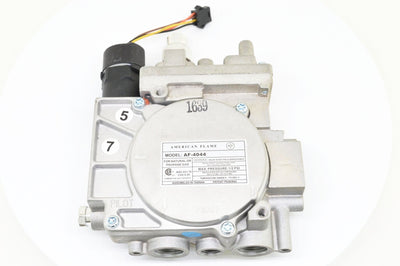
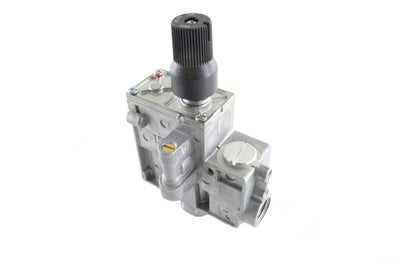
Valve Manufacturer and Model Number
The four major gas valve manufacturers for residential fireplaces are:
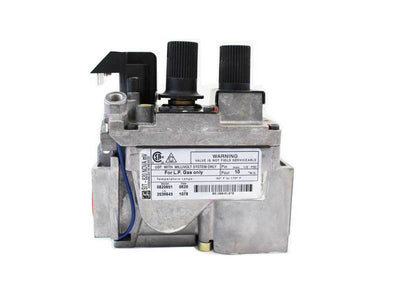
- SIT (Italian Controls) — Common models include the 820 Nova, 630 Eurosit, 710, and 0820639 series. SIT valves are extremely common in Heat N Glo, Heatilator, and many other brands. Model number is stamped on the valve body.
- Honeywell — Look for model numbers starting with VS, VR, or SV. Commonly found in older fireplaces and some newer models.
- Robertshaw — Model numbers often start with 7000 or 7200. Robertshaw is now part of Emerson, but the valve designs remain in production.
- Maxitrol — Model numbers starting with GV. Common in Napoleon and Continental fireplaces, often paired with Mertik Maxitrol remote systems.
Gas Type
Valves are configured for either natural gas (NG) or propane (LP). Using the wrong valve for your gas type is extremely dangerous — it can cause incomplete combustion, carbon monoxide production, or excessive flame. The gas type is marked on both the valve and the fireplace rating plate.
Inlet and Outlet Sizes
Measure the pipe thread sizes for both the gas inlet and outlet connections. Common sizes are 1/2" and 3/4" NPT. The replacement valve must match exactly.
Valve Function
Make sure the replacement valve has the same control functions as the original:
- Pilot valve (thermocouple-controlled safety shutoff)
- Main valve (thermostat/remote controlled)
- Regulator (pressure regulation for flame height)
- Auxiliaries (side outlets for pilot tubing, thermopile connections, etc.)
Browse our complete gas valve collection to find the right replacement by manufacturer and model number.
Tools and Materials Needed
- Replacement gas valve (exact match for your fireplace)
- Two pipe wrenches (or one pipe wrench and one adjustable wrench)
- Pipe thread sealant (yellow Teflon tape rated for gas, or pipe dope rated for natural gas/propane)
- Leak detection solution (or soapy water in a spray bottle)
- 7/16" wrench for thermocouple connection
- Screwdriver set
- Multimeter (for testing after installation)
- Flashlight
- Drop cloth or towels
Step 1: Safety Preparation
- Turn off the gas supply at the main shutoff valve for the fireplace — not just the valve knob. The shutoff is typically a ball valve with a lever handle on the gas supply line before it enters the fireplace.
- Turn off any electrical power to the fireplace if it has an electronic ignition system or blower.
- Wait at least 30 minutes for all components to cool completely.
- Ventilate the area — open a window nearby.
- Take photos of all connections, wiring, and tube routing before disconnecting anything. These photos will be invaluable during reinstallation.
Step 2: Disconnect All Connections from the Old Valve
- Thermocouple: Use a 7/16" wrench to unscrew the thermocouple fitting from the valve. Turn counterclockwise.
- Thermopile leads: Disconnect the spade connectors or unscrew the thermopile terminal screws. Label which wire goes where if there are multiple connections.
- Pilot tube: The small copper or aluminum tube that supplies gas to the pilot. Disconnect it at the valve fitting using an appropriately sized wrench. Be gentle — pilot tubes are soft metal and can kink easily.
- Remote receiver / wall switch wiring: Disconnect any wires running from the valve to the remote receiver, wall switch, or thermostat. Label each wire.
- Main gas inlet and outlet: Use two wrenches (back wrench on the fitting, turning wrench on the valve connection) to disconnect the main gas supply line and the line running to the burner. The back wrench prevents the pipe from twisting while you unscrew the valve.
Step 3: Remove the Old Valve
With all connections disconnected, the valve should be free. It may be mounted with a bracket or screws — remove any mounting hardware. Carefully lift the old valve out, minding any remaining attached tubing.
Step 4: Install the New Valve
- Verify the match: Before installing, compare the new valve side-by-side with the old one. All ports, connections, and mounting points should align.
- Apply thread sealant: Wrap yellow gas-rated Teflon tape clockwise (2-3 wraps) around all male pipe threads, or apply gas-rated pipe dope. Do NOT use white plumber's Teflon tape — it's not rated for gas.
- Connect the main gas fittings: Thread the gas inlet and outlet connections by hand first to avoid cross-threading, then tighten with wrenches. Use the back wrench technique to avoid stressing the pipes.
- Mount the valve: Secure the valve in its mounting bracket or with the original mounting hardware.
- Reconnect the pilot tube: Thread the pilot tube fitting into the new valve carefully. Pilot tube fittings are small and easy to cross-thread.
- Reconnect the thermocouple: Thread the thermocouple fitting into the new valve by hand, then snug with a 7/16" wrench. 1/4 turn past finger-tight.
- Reconnect thermopile leads: Attach the spade connectors or terminal screws to the correct terminals on the new valve. Refer to your photos.
- Reconnect remote/switch wiring: Attach all control wiring to the correct terminals on the new valve.
Step 5: Leak Test
This step is critical and must not be skipped.
- Turn the gas supply back on at the main shutoff valve.
- Leave the gas valve control knob in the OFF position.
- Apply leak detection solution (or soapy water) to every gas connection: inlet, outlet, pilot tube fitting, and any other gas joints.
- Watch for bubbles. Even tiny bubbles indicate a leak.
- If you find any bubbles, turn off the gas immediately, tighten the fitting, and re-test.
- Do NOT proceed to the next step until all connections pass the leak test with zero bubbles.
Step 6: Light and Test
- Turn the control knob to PILOT.
- Press and hold the knob while lighting the pilot.
- Hold for 60 seconds to heat the thermocouple/thermopile.
- Release the knob — the pilot should stay lit.
- Test the main burner by turning the knob to ON and activating the wall switch or remote.
- Verify the flame pattern is correct — even, blue-yellow flames across the full burner length.
- Check that the remote, wall switch, and thermostat all operate the valve correctly.
- Do one final leak check on all connections with the system running.
When to Call a Professional
Gas valve replacement involves working with gas piping and connections. Call a licensed professional if:
- You smell gas at any point during the process
- You find a leak you cannot resolve by tightening fittings
- Your local building codes require a licensed technician or permit for gas work
- The replacement valve doesn't match the original despite having the same model number (manufacturing revisions can change port positions)
- You're not confident in your ability to make leak-free gas connections
- The fireplace has an electronic ignition system with complex wiring you can't trace
Gas leaks are serious safety hazards. If you have any doubt about the quality of your connections, have a professional inspect the work.
Shop Gas Valves
Fireplace Choice carries gas valves from SIT, Honeywell, Robertshaw, and Maxitrol for all major fireplace brands. Visit our gas valve collection to find the exact replacement for your model. If you need help identifying the right valve, reach out with your fireplace model number and the existing valve's model number — we'll make sure you get the correct match.
- Tags: DIY repair, gas fireplace, gas valve, Honeywell, how-to, Maxitrol, replacement, Robertshaw, SIT
← Older Post Newer Post →