
 800-963-5724
What Type of Gas Fireplace Do I Have? Vent Type, Ignition and Model Number
To order the right part or follow the right repair guide, you need three facts about your gas fireplace: how it vents, how it lights, and the brand and model on its rating plate. A flashlight and five minutes will find all three: one look outside, one behind the lower front panel.
Safety first: look with the fireplace off and cool. If you smell gas, do not light anything or touch an electrical switch; leave the house and call your gas supplier from a neighbor's phone.
Gas, Electric or Wood?
A gas fireplace has a gas line, with at least one shutoff valve, feeding a burner under the logs or media. An electric fireplace has no gas line; it plugs in or is wired to a 120 V or 240 V circuit (Dimplex Ignite XL offers both). A wood-burning fireplace has a chimney damper and no burner, unless gas logs were added. More clues: how to tell if your fireplace is gas or electric.
Step 1: How Does It Vent? The Types of Gas Fireplace
Check the outside wall and roof first, then the front of the fireplace.
| Type | At the fireplace | Outside the house | The rating plate says |
|---|---|---|---|
| Direct vent | Fixed glass sealed to the firebox; Empire says never run it with the glass off. | One cap on an outside wall or the roof. All combustion air comes in from outside and all exhaust goes out; on Empire's direct vent fireplaces the vent is a pipe inside a pipe. | Direct vent |
| B-vent (natural vent) | Glass front, but it burns room air and has a draft hood. | A round B-vent pipe and cap on the roof (5 in. on Heatilator's Caliber B-vent). | B-vent, in the model name or code |
| Vent-free (ventless) | No vent at all. An ODS (oxygen depletion sensor) pilot shuts it off if the room runs short of fresh air; Empire says to run its units with the screen in place. | Nothing | Vent-free or unvented |
| Gas insert | A firebox with its own front, set into an existing wood-burning fireplace. | The old chimney with a new cap on top; Empire's DVC direct vent inserts run two 3 in. flexible liners up it, one for combustion air and one for exhaust. | Fireplace insert, plus how it vents |
| Gas logs in a wood-burning fireplace | Logs on a burner pan; vented logs need a damper clamp so the damper cannot close. | An ordinary chimney | Vented decorative appliance (vented logs) or unvented gas log heater (vent-free logs) |
| Electric | No burner, no gas line; a cord or hard wiring | Nothing | Model and serial label (behind the glass on Dimplex) |
Direct vent or B-vent? Both have glass and both can end at a roof cap, so if all you see is a roof cap, let the rating plate decide. B-vent relies on natural draft, which is why Heatilator recommends direct vent instead for basements and other negative-pressure rooms.
Vented or vent-free logs? Read the burner label. Vented logs need a damper clamp, and Empire says not to run them with glass doors closed; vent-free logs have an ODS pilot. Some Empire burners (VFSV series) are certified both ways, so the label decides. Never burn wood in a fireplace that has a gas log set.
Why it matters for parts: the vent type sets the valve version and pilot. SIT's 820 Nova comes as True Millivolt for B-vent (the thermopile powers both the main valve and the pilot safety) and Millivolt Plus, typically used on direct vent (a thermocouple holds the pilot safety). Some Millivolt Plus valves are made for vent-free ODS pilots, and SIT warns never to put a vented-appliance valve on a vent-free fireplace or the reverse. Compare the types in vent-free vs direct vent gas fireplaces; for vent-free pilots, see the ODS pilot assembly guide.
Step 2: How Does It Light? Standing Pilot or Electronic Ignition
Open the louver or access panel below the firebox and look at the valve and pilot.
| Clue | Standing pilot (millivolt) | Electronic (intermittent pilot, IPI) |
|---|---|---|
| With the fireplace off | A small pilot flame keeps burning | No pilot flame, unless set to continuous pilot (below) |
| Valve knob | Marked OFF / PILOT / ON | No OFF / PILOT / ON knob: an ON/OFF switch (Honeywell SmartValve), a MANUAL knob with ON and MAN positions (Mertik Maxitrol GV60), or nothing |
| Igniter | A red push button (piezo) by the valve; one click per press | Clicks and sparks by itself when turned on (Proflame 2 sparks about once a second for up to a minute); Honeywell SmartValve has a hot surface igniter that glows instead |
| Power | None; the thermopile in the pilot flame runs the valve, so it works in a power outage | A module on house power (Proflame 2 plugs into 120 V; IntelliFire Plus and Touch use a 6 V wall adapter), usually with a 4 AA backup, or a battery-powered receiver or module (GV60, AF-4000 kits) |
| HHT model number | No ignition letter (see the Heatilator Caliber example below) | Often an I, IPI or IFT in the model number, such as 6000CLX-IPI or NNXT36-IFT |
Hearth & Home Technologies (HHT) gives the simplest test: a red igniter button in the control area means standing pilot; no red button means intermittent pilot. Two traps:
- A lit pilot does not always mean millivolt. Proflame 2 has a CPI (continuous pilot) setting, IntelliFire Touch a Cold Climate mode and the AF-4000 a Continuous Pilot switch. A control module with a power adapter or battery pack means electronic, even with the pilot lit.
- A battery box does not always mean electronic. Skytech and SIT Proflame 1 receivers on millivolt fireplaces also take 4 AA batteries and have an ON / REMOTE / OFF slider. An OFF / PILOT / ON valve knob with a red igniter button means millivolt.
How the two systems compare: millivolt vs electronic ignition gas fireplaces.
Step 3: Read the Label on the Valve, Module or Receiver
The valve is the block the gas line runs into; its maker and model are printed on it, and electronic systems add a labeled module or receiver.
| What you find | Control system | Guide |
|---|---|---|
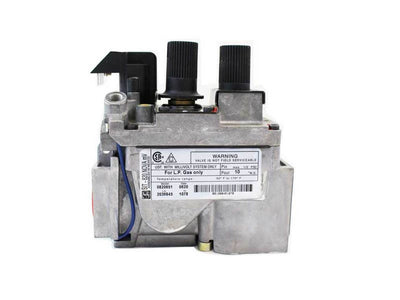
| SIT 820 NOVA mV; OFF / PILOT / ON knob, sometimes a HI / LO knob | SIT 820 Nova (standing pilot) | SIT 820 Nova valve troubleshooting |
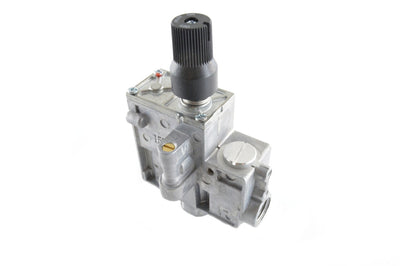
| SIT 630 EUROSIT; one knob with OFF, PILOT and a temperature scale | SIT 630 EuroSIT thermostat valve (standing pilot, needs no power) | Honeywell and SIT 630 valve troubleshooting |
| Robertshaw 7000MVR or a 710-5xx part number; Dexen 6003 | Robertshaw or Dexen millivolt (standing pilot) | Robertshaw and Dexen valve troubleshooting |
| Honeywell or Resideo VS8420, VS8510, VS8520 or VS820 | Honeywell millivolt (standing pilot) | Honeywell and SIT 630 valve troubleshooting |
| Honeywell SV9401-SV9403 or SV9501-SV9503; ON/OFF switch; glowing igniter | Honeywell SmartValve (electronic, 24 VAC) | Honeywell and SIT 630 valve troubleshooting |
| A 120 V board with a 4 AA backup holder, sync button and red LED; remote 0.584.040, .042 or .080 | SIT Proflame 2 (electronic) | SIT Proflame 2 troubleshooting |
| A 4 AA receiver with ON / REMOTE / OFF slider and PRG hole, and no 120 V IFC board; remote 0.584.021, .022, .023, .026 or .027; sometimes a DFC board | SIT Proflame 1 (millivolt or electronic) | SIT Proflame 1 troubleshooting |
| An HHT module (older green IPI module, black IntelliFire Plus module with LEARN button, or IFT-ECM); remote RC300, RC400 or RC450 | IntelliFire, Plus or Touch (electronic) | IntelliFire troubleshooting |
| Valve marked GV60 with a MANUAL knob (ON / MAN); receiver G6R-R3AM or G6R-R3AU; G6R handset on one 9 V | Mertik Maxitrol GV60 (battery electronic) | Mertik Maxitrol GV60 troubleshooting |
| A Skytech receiver (4 AA, ON / REMOTE / OFF slider) wired to a millivolt valve or a 24 V spark ignition module; remote such as the 1001-A | Skytech remote (millivolt valve or 24 V spark module) | Skytech and AF-4000 troubleshooting |
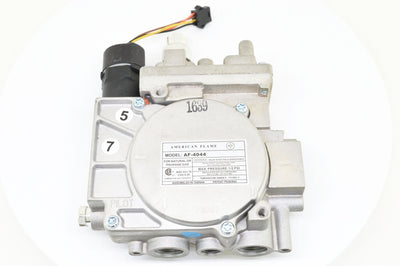
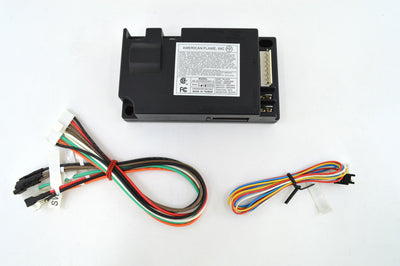
| Black module labeled AF-4000MOD with OFF / REMOTE and Continuous Pilot switches | American Flame AF-4000 (electronic) | Skytech and AF-4000 troubleshooting |
Do not go by remote color: SIT's code list includes silver Proflame 2 handhelds and a black Proflame 1 remote. The code decides.
The Code on Your Remote
Look on the back or under the battery cover. SIT codes start with 0.584 (0.584.040 is a Proflame 2 handheld), Mertik Maxitrol handsets with G6R (such as G6R-H3T5), Skytech prints a date code on the back (its warranty card asks for that and the model, such as 1001-A), and HHT remotes read RC300, IFT-RC400 or IFT2-RC450. Take the code and your fireplace brand to our fireplace remote finder for the exact replacement. If it just stopped working, start with gas fireplace remote not working.
Step 4: Find the Brand and Model on the Rating Plate
The rating plate lists the model, serial number and gas type. Empire asks for the model and serial number when you order parts, and for all three when you need warranty service.
- Heatilator (an HHT brand, like Heat & Glo and Quadra-Fire): on gas fireplaces it is in the controls area, and on inserts near the front; remove the decorative front and the vanity panel and use a flashlight. On stoves it is on the back.
- Electric fireplaces: Dimplex puts the model and serial label behind the front glass.
- Gas type: the plate says natural gas or propane. Empire states that each fireplace is only for the gas on its plate, and some models, such as its vent-free fireplaces, cannot be converted at all. A maker's conversion kit is a job for a qualified gas technician; our gas orifice size chart shows what each orifice size flows.
The model number often spells out the type. HHT's Heatilator Caliber GCBC60IL, for example, reads GC (Gas Caliber), B (B-vent), C (circulating), 60 (36 in. unit), I (intermittent pilot) and L (propane); with no letters after the size it is a standing pilot, natural gas unit.
For other brands, or a missing plate, see how to find your gas fireplace model number. Once you have it, look it up in fireplace parts by model.
Parts by Fireplace Type and Control System
Match the part number on your old part, valve label or manual before you order; most gas parts come in natural gas and propane versions.
More parts: SIT gas valves and controls · fireplace remote controls · gas valves and conversion kits · gas logs · electric fireplaces.
Frequently Asked Questions
What is the difference between a B-vent and a direct vent fireplace?
A direct vent fireplace is sealed: all combustion air comes from outside and all exhaust leaves through its own vent in the wall or roof. A B-vent fireplace burns room air and sends exhaust up a B-vent pipe through the roof by natural draft, so it can spill fumes in a room with negative pressure.
How can I tell if my gas fireplace is vented or vent-free?
Look for a vent cap outside, a chimney or a pipe above the unit. A vent-free fireplace has none, its rating plate says vent-free or unvented, and it has an ODS pilot. Vent-free logs sit in an ordinary fireplace, so read the burner label.
Is my fireplace millivolt or electronic ignition?
A pilot that burns while the fireplace is off, an OFF / PILOT / ON knob and a red igniter button mean millivolt standing pilot. No pilot knob, a module with an adapter or battery pack, and a pilot that sparks only when you turn the fireplace on mean electronic.
My pilot stays lit, but there is a control module. Which is it?
Electronic, set to continuous pilot (Proflame 2 CPI, IntelliFire Touch Cold Climate, AF-4000 Continuous Pilot). Proflame 2 pilot-on-demand boards and American Flame AFVK-SP valve kits (AF-4000 module) turn a continuous pilot off after 7 days without burner use.
Related Guides
- Tags: B-vent, direct vent, electronic ignition, fireplace types, gas fireplace, gas insert, gas logs, Honeywell, identification, IntelliFire, IPI, Mertik Maxitrol, millivolt, model number, rating plate, Robertshaw, SIT Proflame, Skytech, vent-free